Sustainable amount
Start with an amount so small it is easy to keep. You can increase later as your budget allows.
Dollar-cost averaging for Canadian ETF investors
Build a steady ETF investing habit through market dips, rallies, and noisy headlines.
Use this Canadian DCA calculator to compare daily, weekly, biweekly, monthly, and quarterly contribution schedules — then automate the one you can keep.
Simple rule
When you invest the same planned amount on a regular schedule, market noise can work in your favour. Lower ETF prices naturally buy more units. Higher prices buy fewer units. You do not need to guess which day is best — the schedule keeps going.
Same dollars. More units on lower-price days. No guessing the bottom.
Three-step journey
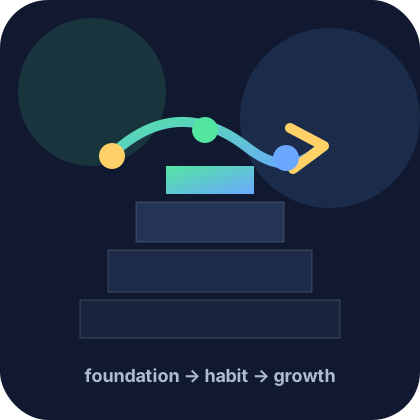
The page follows one path: first confirm the foundation, then automate recurring investing, then understand compounding and withdrawal planning.
Check cash flow, risk comfort, account fit, and sustainability.
2AutomateChoose a recurring amount and schedule you can keep when headlines get loud.
3GrowUse compounding and 4% rule tools to understand long-term scale.
Educational content only, not financial advice. This page is organized as a learning path so beginners can get ready, automate consistently, and then think about long-term growth without treating the site as a personal recommendation.
Start smart
A calm DCA plan is easier to keep when your cash flow, emergency fund, time horizon, and account choice are clear.
Start with an amount so small it is easy to keep. You can increase later as your budget allows.
Keep cash available for real surprises. A cash buffer helps you avoid selling investments at the wrong time.
Short-term money usually needs more stability. Long-term money has more time to ride through market cycles.
TFSA, FHSA, RRSP, RESP, and taxable accounts all have different uses. Choose the account that fits your goal.
Pick an investment mix you can keep holding when markets are noisy.
If you have credit card debt or other very high-interest debt, paying it down may be the stronger first move.
This checklist is not meant to block investing. It is meant to make the habit easier to keep, especially when markets are noisy or life gets expensive. Personal circumstances can change which account or contribution amount makes sense.
Risk and comfort
The right investment is not just the one with the highest expected return. It is the one you can keep buying and holding through rough markets.
May fit money you expect to need soon.
Mixes stocks and bonds for investors who want a less aggressive ride.
May fit long timelines and investors who can handle larger swings.
Broad equity ETFs are diversified, but they can still fall during market downturns. If large drops would make you sell, consider a smoother investment mix.
Diversification reduces company-specific risk. It does not remove market risk, currency risk, possible loss of principal, or the emotional challenge of holding through downturns.
Why calm investors automate
Market headlines can make every contribution feel like a decision. Dollar-cost averaging turns that decision into a system: same amount, same rhythm, long-term plan.
Regular ETF buys spread your entries across many market days. Some buys land higher, some lower, and the plan keeps moving.
Small recurring contributions are easier to keep than occasional big decisions. The habit matters more than finding the perfect day.
For people investing from income, payday-based, weekly, monthly, or daily DCA can all work. Choose the schedule you can automate and keep.
A one-time investment can be a strong start, but it is not a complete habit. The core message of this site is to keep investing at a sustainable daily, weekly, payday, or monthly rhythm after the initial buy.
Market noise playbook
Red days, green days, and scary headlines are normal. A fixed DCA schedule keeps the question simple: does the plan still fit your life?
A down day does not automatically mean stop, panic, or change the plan.
A rally does not mean you missed your chance. The habit continues either way.
If your emergency fund, debt situation, time horizon, and risk tolerance still support long-term investing, the schedule can keep doing its job.
This is educational guidance, not personal advice. If your income, debt, emergency fund, goal, or risk tolerance has changed, review your plan before contributing more.
Sustainable investing
The calm plan is not the most aggressive plan. It is the one you can keep after bills, debt priorities, emergency savings, and normal life expenses.
DCA works best when the money is truly available for long-term investing. Keep bill money, rent money, and emergency savings separate from your investment habit.
Keep emergency cash available so market drops do not force you to sell at the wrong time.
If a contribution amount creates stress, it is too high. Sustainable beats aggressive.
A $5 weekday coffee is $25 a week, about $100 over four weeks, or roughly $1,200 a year. If that money is truly optional, you could automate it into your investing routine instead.
A $5 weekly lottery ticket is $260 a year. Investing is not guaranteed either, but diversified investments have a rational long-term wealth-building purpose. Lottery tickets are entertainment.
A cash buffer reduces the chance that an emergency forces you to sell investments during a market downturn. Investing involves risk, including possible loss of principal, so short-term money usually belongs somewhere more stable. The coffee and lottery examples are not about those purchases specifically; they show how small discretionary amounts can become an automated investing habit when repeated over time.
When to withdraw
Selling can make sense when the money is needed for a planned goal, an emergency, rebalancing, or reducing risk before a known expense.
What usually hurts long-term investors is panic selling: selling only because the market dropped and the chart feels scary. Review your goal, timeline, and investment mix before reacting.
For Canadians: TFSA withdrawals restore your contribution room in the next calendar year, so money you take out for a real goal can be replaced later. That flexibility can make a TFSA useful for long-term investing when it fits your situation.
Home down payment, education, a planned purchase, or another clear use.
Unexpected urgent expenses can happen. Ideally, use cash savings first.
A market drop alone is not a plan. Review your goal, timeline, and investment mix before reacting.
Selling can be appropriate when it matches a goal, rebalancing plan, or changing time horizon. The behaviour to avoid is panic selling only because the market fell.
Choose your calm schedule
Daily DCA is the default because it makes investing feel automatic and spreads contributions across more market days. Weekly, biweekly, monthly, and quarterly investing can also work. The best schedule is the one you can keep when headlines get loud.
The exact cadence matters less than continuing after the first investment. Daily and weekly are useful because they turn investing from a one-time event into an ongoing behaviour. Choose the schedule you can automate through both calm and rough markets.
Steady DCA calculator
Each schedule invests the same total amount over one year. Click any schedule to compare the others against it, then test calm, rising, choppy, or rough market scenarios.
Educational estimate. Actual market returns vary.
Calculator results are simplified estimates based on the assumptions you choose. They are meant to teach contribution timing, not predict returns.
Scroll the table to compare the daily value of each recurring schedule. The table updates whenever you move the sliders.
The chart compares timing, not a complete financial plan. Calculator results are simplified estimates based on user-selected assumptions and do not include tax, inflation, fees, currency effects, account rules, or real-world behaviour during market stress. Real returns vary and can be negative.
Get started
A simple walkthrough for opening the right accounts and turning recurring contributions into an automated habit.
Create your account and verify your identity. This gives you access to Cash, TFSA, RRSP, FHSA, and trading account options.
Use the referral link and get an extra $25 when you make your first deposit.
You can link a bank account directly or use a Wealthsimple Cash account as a staging place before investing.
Guide: Choose an account to open ↗Many Canadian long-term investors consider a TFSA first when they have contribution room, but account choice depends on your goals.
Guide: Choose an account to open ↗Choose an ETF example to research, pick your contribution amount, select the schedule, and let automation handle the habit.
Guide: Set up a recurring investment ↗Wealthsimple is included because it supports recurring ETF purchases for Canadians. Compare platforms, fees, account types, FX costs, and current terms before choosing a brokerage. Referral links may provide a benefit to the site owner.
Diversified building blocks
A broad ETF can spread your money across many companies, sectors, and sometimes countries. That makes it easier to build a simple long-term investing habit without betting everything on one company or sector.
Diversified exposure across many companies. A common research starting point for long-term investors.
A mix of stocks and bonds for investors who want a smoother ride than an all-equity portfolio.
More concentrated. One company or sector can struggle for years, even while the broader market grows.
Broad ETFs simplify diversification, but they still move with markets. Sector ETFs and individual stocks add more concentration risk. ETF tickers are examples for research, not personal recommendations.
ETF examples
Use these as a starting point for your own research. Compare fees, holdings, risk rating, account fit, currency exposure, and tax treatment before choosing.
Showing Canadian-listed ETF ideas.
Other all-in-one ETFs, such as VEQT, may also be worth comparing. The best fit depends on your account, time horizon, comfort with volatility, fees, and desired exposure.
These examples are not ranked recommendations. Review fund facts, MER, holdings, currency exposure, distribution history, tax treatment, and whether the fund fits your risk tolerance before choosing. ETF tickers are examples for research, not personal recommendations.
For Canadian investors
For Canadians and Canadian residents, a TFSA can be a flexible place to hold long-term ETF investments because eligible growth and withdrawals are generally tax-free in Canada.
For some investors, an FHSA, RRSP, employer match, debt repayment, or another priority may come first. The right account depends on your goal and situation.
TFSA contribution room is personal. Withdrawals generally restore room in the next calendar year. Confirm your official room with CRA My Account.
Estimate your remaining TFSA contribution room using your eligibility year, past contributions, and last year’s withdrawals. TFSA limit data last updated for 2026.
Confirm your official TFSA contribution room and account rules with official sources such as CRA My Account. Foreign withholding tax can still apply to some foreign dividends inside a TFSA, especially U.S. dividends.
Compounding over time
At first, your contributions do most of the work. Over time, a larger balance gives investment growth more room to matter. That is why consistency and patience are so powerful.
Years 1–8
Most of the visible progress comes from your own contributions. The account may not feel exciting yet, but the habit is doing its job.
Years 9–12
As the balance grows, the same percentage return creates more dollars of growth. Compounding becomes easier to see.
Years 13–15
With a larger base, investment growth can start to do more of the heavy lifting during strong markets.
Rule of 72 + DCA calculator
The Rule of 72 gives a quick mental shortcut: divide 72 by the return assumption to estimate how many years it takes money to double. Then use your daily contribution below to see how compounding changes the path.
At an 8% annual return, money roughly doubles in about 9 years. Inflation, taxes, fees, and real market returns affect purchasing power. Use this as mental math, not a promise.
Results are estimates based on the return assumption you choose. Try lower and higher scenarios to understand the range of possible outcomes.
Income target
The 4% rule is a simple retirement-planning shortcut: multiply the annual portfolio income you want by 25. In formula form: desired annual income ÷ 4%.
Use this as a conservative scale estimate, then compare it with your current balance, monthly investing habit, and return assumption.
Recommended term: 4% rule income target. Using CAGR as “self-replenishing income” can be misleading because average long-term returns are not reliable yearly cash flow. The 4% rule is still simplified, but it is more conservative because it separates a spending/withdrawal assumption from the portfolio’s growth assumption. Taxes, fees, inflation, account rules, and personal circumstances can change outcomes.
Some investors call this the 8-4-3 rule. Treat it as a memorable way to understand patience, not an exact schedule. For official investor education on compounding, see Investor.gov’s compound interest calculator.
Timing risk
The problem is not intelligence. The problem is emotion, uncertainty, and consistency. DCA removes the pressure of deciding whether today is the perfect day to invest.
For people investing from paycheques, DCA is a natural fit because the money arrives over time. If you receive a large lump sum, you can invest it all at once or phase it in based on your comfort level — but either way, the key habit is to keep investing from income afterward.
Sources: Barber, Lee, Liu & Odean, “Do Individual Day Traders Make Money?”; RBC GAM, “Benefits of investing regularly and dollar cost averaging”
Research on individual day traders shows how difficult short-term timing can be. DCA is different: it is a long-term contribution system, not a trading strategy.
A one-time investment can help, but long-term investing usually comes from repeatable contributions. If you phase in a lump sum, keep it fixed and planned rather than changing contributions based on market drops.
FAQ
Dollar-cost averaging means investing a fixed amount on a regular schedule. When prices are lower, the same amount buys more units. When prices are higher, it buys fewer units.
If your time horizon, emergency fund, debt situation, and risk tolerance still support long-term investing, a fixed DCA schedule can help you avoid emotional timing decisions. If your personal situation has changed, review the plan before contributing more.
Not exactly. DCA means investing a fixed amount on a regular schedule. Lower prices naturally buy more units, but the point is not to guess the bottom. The point is to keep the habit steady.
Daily DCA spreads contributions across the most market days, but weekly, biweekly, payday-based, and monthly investing can also work. The key is to keep investing at a rate you can automate and sustain.
Nervousness is a signal to review your plan, not automatically abandon it. Check your cash buffer, debt, time horizon, contribution amount, and investment mix. If the plan still fits, the schedule can keep going.
Yes. Many Canadians use a TFSA for recurring ETF investments when they have contribution room. Confirm your official TFSA room and account fit before contributing.
Many Canadians research broad-market or all-in-one ETFs for long-term DCA. Examples include Canadian-listed ETFs that cover U.S., Canadian, or global markets. Compare fees, holdings, risk rating, and account fit before choosing.
The Rule of 72 estimates how long money takes to double: 72 divided by the annual return equals the approximate number of years.
If you already have a large lump sum, investing sooner has often performed better historically because markets tend to rise over time. But DCA may be easier emotionally and can help investors avoid sitting in cash out of fear.
You can invest it all at once or use a temporary fixed DCA schedule to phase it in. The important part is that the lump sum does not replace the ongoing habit: keep investing from income afterward if your budget allows.
Use conservative assumptions and test multiple scenarios. A higher assumption makes the output look better, but it does not make the result more likely.
No. ETF tickers are examples for research. The right choice depends on your account, time horizon, fees, tax situation, currency exposure, and comfort with market swings.
Canadian TFSA growth and withdrawals are generally tax-free for Canadian tax purposes, but foreign withholding tax can still apply to some foreign dividends, especially U.S. dividends.
The 4% rule is a simplified retirement-planning shortcut that estimates a portfolio target by dividing desired annual income by 4%. It is a planning rule of thumb, not a guarantee.